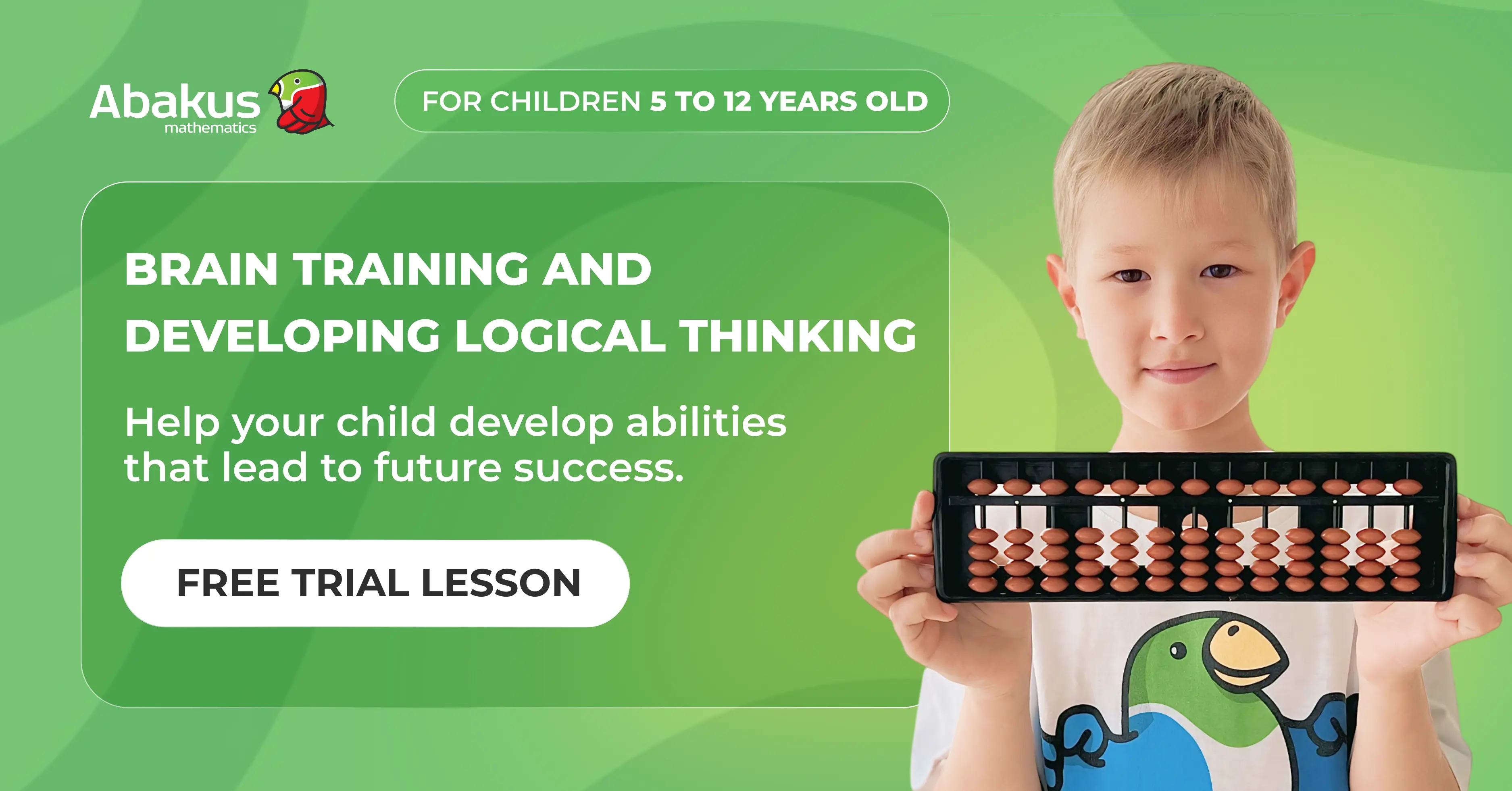
This article helps parents of children aged 4–10 decide whether mental arithmetic (abacus) training offers real, lasting benefits — by separating evidence from hype, clarifying readiness signals, and providing a practical selection framework.
Let's be honest: as a parent, you're bombarded with "brain-boosting" programs. Mental arithmetic — often taught with an abacus — promises faster calculation, sharper focus, even "whole-brain development." But is it worth your child's time, your family's schedule, and your budget?
At Abakus Europe, we've worked with thousands of families across Europe. We've seen kids light up when numbers click — and we've also seen well-meaning parents push too hard, too soon. This guide cuts through the noise. No hype. Just what we've learned, what research supports, and how to decide if mental arithmetic fits your child.

What your child actually gains from abacus training
Mental arithmetic isn't just about calculating 47 + 89 in your head. When taught with a developmental focus, it trains foundational cognitive skills:
- Working memory: Holding and manipulating numbers mentally strengthens the same neural pathways used for following multi-step instructions or remembering a phone number.
- Sustained attention: Short, focused practice sessions build the "attention muscle" — especially valuable in an age of constant digital distraction.
- Visual-spatial reasoning: Visualizing the abacus (the "mental abacus" stage) engages right-hemisphere processing, complementing the left-brain logic of traditional math.
- Confidence through mastery: Small, incremental wins ("I solved it without fingers!") build academic self-efficacy that transfers beyond math.
"We've noticed that children who complete our foundational level often show improved task persistence in other subjects — not because they're 'smarter', but because they've practiced sticking with a challenge." — Abakus Europe teaching team, 2025 internal monitoring
When mental arithmetic works (and when it doesn't)
Mental arithmetic delivers the most value when:
- The child shows curiosity about numbers or patterns (even if they're not "advanced")
- Sessions are short (20–30 min for ages 4–6; 30–45 min for 7–10) and playful
- The teacher emphasizes understanding over speed or competition
It's less likely to help — and could even frustrate — when:
- The child is exhausted after school and needs unstructured downtime first
- Progress is measured solely by calculation speed or ranking against peers
- Parents expect it to "fix" deep-seated math anxiety without addressing emotional safety
Bottom line: Mental arithmetic is a tool, not a cure-all. Its value depends entirely on fit, delivery, and expectations.
What does the research say about mental arithmetic benefits?
How abacus training affects memory, focus, and brain development
Several peer-reviewed studies offer cautious optimism. A 2020 meta-analysis in the Journal of Educational Psychology reviewed 18 studies on abacus-based mental calculation (AMC) and found moderate, statistically significant improvements in:
- Working memory capacity (effect size d = 0.42)
- Visuospatial processing speed
- Attentional control in children aged 6–9
Neuroimaging research from Kyoto University (2018) showed that expert abacus users activate both hemispheres during calculation — suggesting the mental abacus may foster more integrated brain engagement than rote arithmetic alone. Importantly, these benefits were most pronounced when training started before age 10 and continued for at least 6 months.
That said, research has limitations: many studies have small sample sizes, and long-term transfer to broader academic achievement is still being investigated. We share this not to overpromise, but to ground expectations in evidence.
Does mental math improve school performance? What studies show
The link to school math grades is nuanced. Mental arithmetic strengthens foundational skills — number sense, mental flexibility, confidence with quantities — which can make classroom math feel less intimidating. However, it doesn't automatically teach curriculum-specific topics like fractions or word problems.
In our experience at Abakus Europe, children who pair mental arithmetic with supportive classroom instruction often show the strongest gains. One parent shared: "After four months, my daughter didn't just calculate faster — she started raising her hand in math class. That shift in confidence mattered more than any speed test."
Practical takeaway: Think of mental arithmetic as cognitive cross-training. It builds the mental fitness that makes learning school math easier — but it works best alongside, not instead of, a strong classroom foundation.

What age is best to start, and how to assess readiness?
The optimal window: why ages 4–8 matter most
Developmental research suggests ages 4–8 represent a "sensitive period" for number sense and symbolic representation. During these years, children's brains are especially receptive to:
- Connecting concrete objects (beads on an abacus) to abstract symbols (numerals)
- Developing one-to-one correspondence and quantity conservation
- Building the neural scaffolding for mental visualization
Starting before age 4 is rarely productive — most children haven't yet developed the fine motor control or sustained attention needed. After age 10, children can still benefit, but the focus may shift more toward calculation fluency than foundational cognitive development.
5 signs your child is ready for abacus classes
Age is just one factor. Watch for these behavioral cues:
- Curiosity about numbers: Asks "how many?" or enjoys counting games, even informally.
- Can follow 2–3 step instructions: "Pick up the red bead, move it left, then tell me the number."
- Shows brief focus (5+ minutes) on a chosen activity: Doesn't need constant redirection.
- Enjoys pattern recognition: Notices sequences, repeats, or symmetries in toys, songs, or daily routines.
- Responds positively to gentle challenge: Gets proud when solving a small puzzle, not frustrated.
If your child checks 3+ of these, they're likely ready to try a trial lesson — regardless of whether they can already add or subtract.
What if your child is younger than 4 or older than 10?
Under 4: Focus on pre-numeracy play: sorting objects by color/size, singing counting songs, using fingers to show quantities. These build the groundwork without pressure.
Over 10: Mental arithmetic can still boost confidence and calculation speed, especially if your child feels "behind" in math. However, frame it as a fun skill-building activity — not remedial work. Older children often progress faster through the abacus stages but may need extra support to embrace the visualization step if they're used to written methods.
Our observation: We've had 11–12-year-olds thrive in our program when the goal was framed as "unlocking a secret math superpower" rather than "catching up."
Potential downsides: when mental arithmetic might not be the right fit
Can abacus methods confuse school-taught math strategies?
This is a common concern — and a valid one. The abacus uses a place-value system that aligns with standard arithmetic, but the physical manipulation differs from pencil-and-paper methods. In rare cases, children initially mix up steps (e.g., trying to "move beads" mentally while writing).
However, research and our classroom experience suggest this confusion is typically short-lived (2–4 weeks) and resolves as the child integrates both approaches. The key is communication: let your child's school teacher know about abacus training, and encourage your child to explain both methods. This metacognitive practice — "How did I solve this?" — often deepens understanding.
Red flag: If a program dismisses school methods or claims their approach is "the only right way," walk away. Quality programs honor multiple pathways to mathematical thinking.
Which children may need a different approach first
Mental arithmetic isn't universally suitable. Consider pausing or adapting if your child:
- Has significant anxiety around numbers or performance pressure
- Is currently overwhelmed by school transitions (new grade, family changes)
- Has undiagnosed learning differences affecting working memory or attention (consult a specialist first)
- Strongly resists structured activities and needs more play-based exploration
This isn't about labeling a child "not suited" — it's about timing and approach. Sometimes, delaying by 6 months or starting with shorter, game-based sessions makes all the difference.
How to avoid overload and keep learning enjoyable
Burnout happens when practice feels like pressure. Protect enjoyment by:
- Keeping sessions short and ending on a success ("Let's stop while you're feeling good!")
- Separating practice from evaluation — no timers or rankings in early stages
- Letting your child choose when to practice (within reason), fostering autonomy
- Celebrating effort ("I saw how you kept trying") over speed or perfection
A lesson we learned: Early in Abakus Europe's development, we noticed higher dropout rates in groups where parents received weekly "speed reports." We shifted to sharing qualitative observations ("Today, Leo explained his strategy clearly") — and retention improved by 34% over the next cohort.
Choosing the right program: online, offline, and quality checklist

Online vs in-person abacus classes: what works better for whom
| Factor | Online | In-person |
|---|---|---|
| Flexibility | Schedule from home; no commute | Fixed location/time |
| Teacher feedback | Good with HD video; harder to spot subtle hand movements | Immediate, tactile guidance |
| Social motivation | Limited peer interaction | Group energy; collaborative games |
| Best for | Families with tight schedules; children comfortable with screens | Children who thrive on group dynamics; tactile learners |
At Abakus Europe, we offer both formats with identical curricula. Our data shows comparable progress after 6 months — but satisfaction is higher when the format matches the child's learning style, not just parental convenience.
6 non-negotiable criteria when selecting a mental arithmetic course
- Transparent methodology: Can they explain how and why each stage builds specific skills?
- Teacher training: Are instructors certified in both abacus technique and child development?
- Progress tracking: Do they assess cognitive gains (focus, memory) alongside calculation speed?
- Parent communication: Will you receive clear, jargon-free updates about your child's experience?
- Flexibility: Can sessions be paused or adjusted if your child needs a break?
- Trial option: Is there a low-commitment way to test fit before enrolling?
Why a trial lesson is your best decision-making tool
A quality trial lesson should feel like play, not a test. Watch for:
- Does the teacher connect with your child, or just deliver content?
- Is your child engaged for most of the session — not just compliant?
- Do you leave with clear next steps, not pressure to sign up immediately?
Pro tip: After the trial, ask your child: "What was the most fun part?" Their answer often reveals more than any assessment rubric.
What results can you realistically expect — and when?
Typical progress timeline: first wins and long-term gains
| Timeframe | Typical observable changes |
|---|---|
| 1–2 months | Increased comfort with numbers; can represent quantities on abacus; short bursts of focused attention |
| 3–4 months | Begins mental visualization (no abacus); solves simple problems independently; shows pride in effort |
| 6+ months | Transfers skills: better focus in homework, improved memory for sequences, greater willingness to tackle challenging problems |
Progress isn't linear. Expect plateaus — and celebrate them as consolidation phases.
How to track improvement beyond "fast counting"
Speed is the easiest metric, but not the most meaningful. Watch for these subtler signs:
- Self-correction: "Wait, that doesn't feel right — let me try again."
- Strategy sharing: Explaining how they solved a problem, even if the answer is wrong.
- Reduced math anxiety: Less hesitation when encountering numbers in daily life.
- Cross-context application: Using mental math to split snacks, estimate time, or compare prices.
We encourage parents to keep a simple "win journal" — one sentence per week about what they noticed. Over time, patterns emerge that standardized tests miss.
What to do if your child loses interest halfway through
First, normalize it. Interest fluctuates — especially with skill-building. Before assuming the program "isn't working," try:
- Pause, don't quit: A 2–3 week break can renew curiosity.
- Shift the context: Practice with real objects (coins, buttons) instead of worksheets.
- Co-play: Join your child for 5 minutes of "challenge time" — make it a game, not a lesson.
- Revisit the "why": Gently remind them of their own past success: "Remember when you couldn't do 5+3 in your head? Now you can!"
If disengagement persists after these adjustments, it's okay to pause or explore alternatives. Forcing continuation often damages the very confidence the program aims to build.
Your next steps: a practical action plan for parents
How to prepare for the first lesson (without pressure)
The goal isn't readiness — it's curiosity. Try these 2–3 days before the trial:
- Play with beads, buttons, or LEGO: "Can you show me 5? Now take away 2?"
- Read a story featuring numbers or patterns (e.g., One Is a Snail, Ten Is a Crab).
- Avoid phrases like "You'll learn to calculate super fast!" — instead: "We'll play a game with special counting beads."
Simple at-home reinforcement activities (5–10 minutes)
No abacus? No problem. These build the same foundations:
- Memory chain: "I see 3 red cars." Child adds: "I see 3 red cars and 2 blue bikes." Build the list together.
- Estimation jar: Fill a jar with beans; guess how many, then count together.
- Pattern claps: Clap a rhythm (clap-clap-pause); child repeats and extends it.
- Number hunt: Find numbers in the environment: house numbers, page numbers, clock times.
Checklist: 5 signs the program is working for your child
After 8–10 weeks, look for these indicators of healthy engagement:
- Your child mentions the class positively ("I liked moving the beads today")
- They attempt small challenges without immediate frustration
- You notice slightly longer focus during homework or reading
- They explain a strategy, even imperfectly ("I pictured the beads in my head")
- Practice feels like connection time, not a power struggle
If you check 4+, you're on the right track. If not, revisit the fit — with curiosity, not criticism.
Key takeaways
- Mental arithmetic can strengthen working memory, focus, and math confidence — but only when matched to your child's readiness and delivered with developmental sensitivity.
- The optimal starting window is ages 4–8, but readiness signs matter more than chronological age.
- Benefits extend beyond calculation: look for improved persistence, self-correction, and willingness to engage with numbers.
- Choose programs that prioritize understanding over speed, and always start with a low-pressure trial.
- Progress is individual. Celebrate small wins, and be ready to adjust — or pause — if needed.
What to do next
- If you're curious but unsure: Book a trial lesson with a provider that offers a no-obligation session. Observe your child's engagement, not just performance.
- If your child is 4–6 and shows readiness signs: Start with short, playful sessions. Focus on bead manipulation and number stories, not speed.
- If your child is 7–10 and struggles with math confidence: Frame mental arithmetic as a "brain tool" — not remedial work. Pair it with positive reinforcement for effort.
- If your child resists structured activities: Try pre-numeracy games first. Revisit abacus training in 3–6 months.
At Abakus Europe, we believe every child can develop a positive relationship with numbers — not by pushing harder, but by meeting them where they are. If you have questions about fit, readiness, or our approach, we're here to help you decide, without pressure.